
External links
Downloads
The Catford Photographs
These early photographs of Lundy were passed down to LFS member Chris Blackmore from his grandfather. Research shows them to be by J S Catford an early postcard pioneer. St Helen's church, for which funding was obtained in 1895 has yet to be built, dating the photographs to 1895 or earlier. An article explaining the history of the photographs can be found in the Bulletin of the Lundy Field Society Discovering Lundy No 47 published in February 2018.
The album pages are shown below. You can enlarge each photograph by clicking it.


Rowland Barker's photographs of Lundy
Rowland Barker was appointed the first warden by the Lundy Field Society for the 1947 season on the island. As well as recording information for the Lundy Bird Observatory he was in charge of the LFS's hostel which was in the Old Light. The building had been completed in 1820 but soon rendered obsolete as its height on the top of the island meant it was often obscured by clouds. The keepers' house had been repaired during World War II when a small naval detachment had been quartered there but it was again showing the effects of the severe weather. Barker maintained the buildings and cooked for visitors.
The following year, Barker is described in the list of members as "somewhere in Canada". He retired to Oregon after a life in the hotel trade and his photograph album came to light when many of his posessions were sold prior to moving into a home. The LFS is grateful to Bob Cummings, who purchased the album at the sale, for providing the images.
The album pages are shown below. You can enlarge each photograph by clicking it.


There are also 8 full page photos
 |
 |
 |
 |
 |
 |
 |
 |
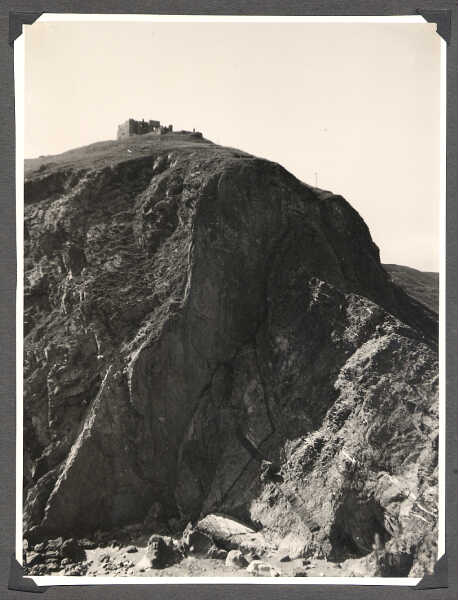
Three loose photos
 Two of these were copies of the Knights Templar Rock photo but the third showed this man on the beach holding a shovel.
There is a more detailed account of the the Lundy Wardens in the book Island Studies.
Tony Holbrook's Lundy Bibliography
Tony Holbrook was a librarian at the University of Bath from 1975 until his his death on 22 March 2005 at the age of 58. He was Faculty Librarian for the Faculty of Humanities and Social Sciences and also served for a decade as the Honorary Librarian for the Royal Bath and West Society.
He was the author of two bibliographies, both published by the University: Tidal Barrages in the Severn Estuary: A Bibliography appeared in four editions, whilst Lundy Island: A Bibliography was published in 2000. A copy of this may be downloaded here.
We are grateful to Tony's family and the University of Bath for allowing us to use his information.
Boniface Centre Directions
Road
The Boniface Centre is adjacent to Crediton's parish church. Look out for the signs, 'Parish Church Boniface Centre'. For sat-navs the postcode is EX17 2AH. Plenty of parking is available behind the church down the lane on the east side of the churchyard and beyond the centre and neighbouring dairy.
Rail
Due to planned engineering works on 8 March 2025, the day of the AGM, a replacement bus service will be in operation between Exeter and Okehampton, and between Exeter and Barnstaple.
Trains normally run twice an hour from Exeter St David's and hourly from Okehampton or Barnstaple, calling at Crediton (10-12 minutes from Exeter, 23 minutes from Okehampton and 50-55 minutes from Barnstaple). The Boniface Centre is a fifteen minute, uphill, walk from the station. For train times or to book tickets see the GWR website or the National Rail Enquiries Journey Planner.
Bus
From Exeter bus station take the Stagecoach route 5, 5A, 5B, 5C or 369 buses to Crediton. The journey time is approximately 30 minutes. For times and fares, see the Stagecoach website.
From Barnstaple bus station or Bideford Quay take the Stagecoach route 5B bus towards Exeter. The journey time is approximately 2 hours 10 minutes from Barnstaple and 1 hour 40 minutes from Bideford. For times and fares see the Stagecoach website.
Lundy Marine Protected Area Zoning Scheme

What is a No Take Zone (NTZ) and why is it important?
A No Take Zone (NTZ) is a marine protected area (MPA) where all fishing and other removal of wildlife are prohibited. NTZs are used to protect marine wildlife and heritage and to safeguard or improve local fish stocks for future generations. Such closed areas can play an important part in the future of the marine environment, allowing the marine habitats to thrive with minimal human interference. NTZs may be created in isolation, be surrounded by normal fishing grounds, or form part of a larger marine reserve, like the Lundy marine protected area, which is managed for nature conservation.
When it was set up in 2003, the Lundy NTZ was the first of its kind in the UK. Nothing of a living nature is allowed to be removed from it. The NTZ is protected by law and has been monitored to determine what environmental benefits it is providing. Lobsters are thriving within the closed area which could be a benefit to nearby shellfisheries.