A wide range of invertebrates can be found on Lundy. Over the years around 1500 species have been recorded in Annual Reports by casual and specialist surveyors. Many Groups are represented, Spiders, Woodlice, Myriapods, Damselflies and Dragonflies, Grasshoppers and Crickets, True Bugs, Beetles, Flies, and Bees Wasps and Ants.
An exhaustive list is not attempted here but the more common and visible species are described and, where possible, illustrated. Click on any image to view a larger version.
Each Class has a link to the definitive list of species recorded on Lundy, where their status is described using the DAFOR scale:
- Dominant 50-100%
- Abundant 30-50%
- Frequent 15-30%
- Occasional 5-15%
- Rare < 5%
We have used this scale to indicate what percentage of years the species has been recorded on Lundy. Please treat these assesments with caution as much depends on there being a specialist present on Lundy when the species is liable to been seen and on whether this results in a record being entered in the LFS log book. Most species are severely under-recorded and all records are welcome.
Molluscs
While slugs are abundant in damp weather, which is not uncommon on Lundy, they are very under recorded. Similarly, whilst the large Garden and Brown-lipped Snails can be easily found records are rarely seen in the log book. The remaining snails are quite small and can only usually be found by diligent stone turning or wall inspection. The Lundy list of Terrestrial molluscs can be viewed here.
Spiders (Arachnida)
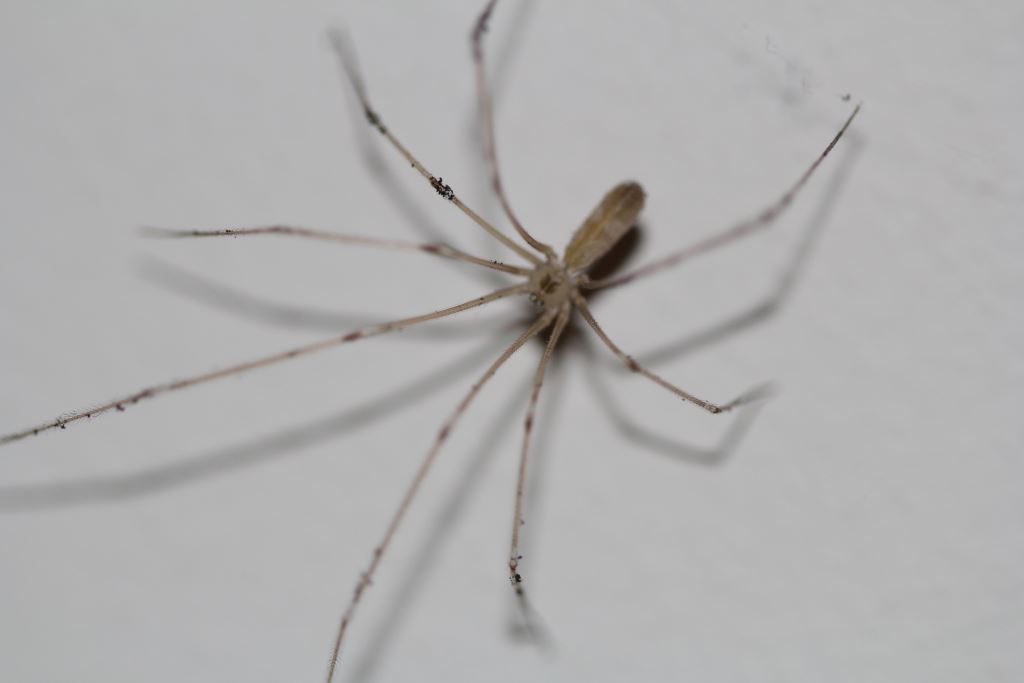
Two spiders are, if not common, easily found. The Cave Spider can be searched for in Benson’s Cave or the Cave along the Landing Beach.
The Cellar Spider is easily confused with Daddy Long-legs. As a spider it has 8 not 6 long spindly legs. It can be found in the upper corners of most properties and should be cherished as it not only eats flies, but also other spiders.
View the Lundy list of Spiders, Harvestmen and Mites here.
Woodlice (Isopoda)
The Common Shiny Woodlouse Oniscus asellus is found all over the island, but a rather more interesting yet easily found species is the Ant Woodlouse Playarthus hoffmannseggi. Whilst looking for ants under stones, you might chance upon this tiny white wood louse. Don’t be fooled into thinking this is a juvenile, it is fully grown at 4 mm and pure white. View the lundy list of Woodlice here.
Myriapods - Millipedes, Centipedes (Diplopoda and Chilopoda)

 There is one centipede that can usually be seen indoors and under stones, but it is very fast moving. The Banded Centipede Lithobius variegatus is extremely common and quite large. Its distinctive banded purple legs easily identify it.
The Pill Millipede Glomeris marginata (not to be confused with the Pill Woodlouse Armadillidium vulgare – check the number of legs) is very common on the Lower East Side Path to the north of Halfway Wall. It has 2 pairs of legs per segment, rolls into a almost perfect sphere and, on Lundy, shows yellow edges to each segment.
The Lundy list of Centipeded and Millipedes can be viewed here.
Dragonflies and Damselflies (Odonata)
Out of 57 UK species, 14 have been reported from Lundy (see article in 2015 Annual Report and the Lundy list here). Of these there are four that can reliably be seen. Blue-tailed Ischnura elegans and Common Blue Enallagma cyathigerum Damselfies, Migrant Hawker Aeshna mixta and Common Darter Sympetrum striolatum are all reported annually and can be seen around the many freshwater bodies and well away from them too. The two “blues” can be distinguished by the colour of their abdomen. The Blue-tailed has a blue tail – i.e. black abdomen with segment 8 blue, whereas the abdomen of the Common Blue is alternately black and blue.


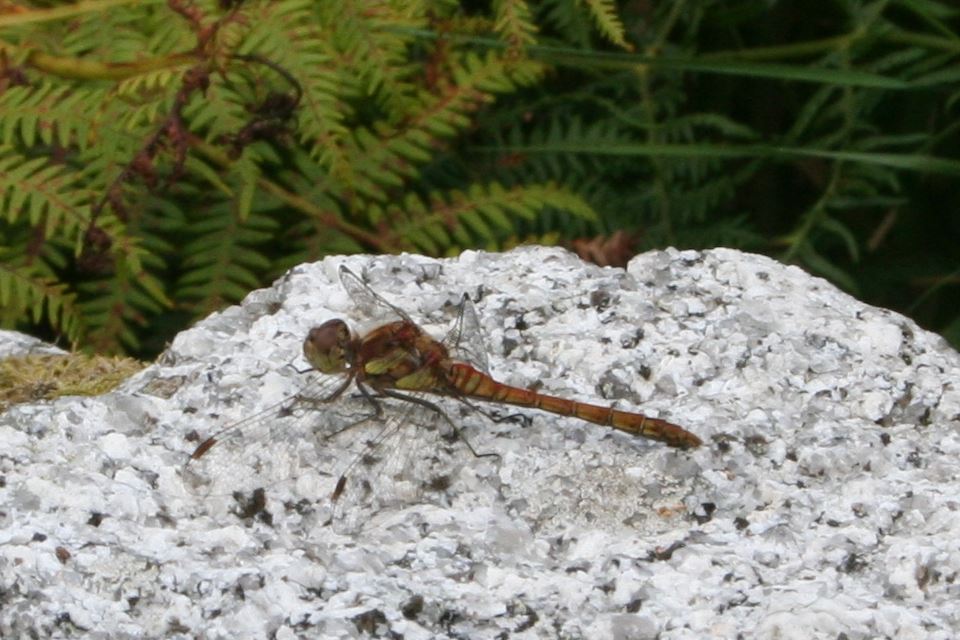
The Migrant Hawker is a medium sized dragonfly predominantly blue but the identifying feature is the yellow triangle where thorax and abdomen meet.
The Common Darter is a small restless dragonfly with a orange-red or brown abdomen is not uncommon and can be seen most years
A fifth species, Four-spotted Chaser Libellula quadrimaculata is rarely seen, but in 1963 there was a mass eruption with thousands appearing all over the island.

Grasshoppers and Crickets (Orthoptera)
One of each species is common on the island. The Common Field Grasshopper Chorlhippus brunneus is reported in most years but comes in a range of colours including a rich brown, purple and pink. Increasingly the Speckled Bush Cricket Leptophyes punctatissima can also be found.
Any newly discovered species will be added to the list here.

True Bugs (Hemiptera)
Shield Bugs are increasingly being seen and reported with the most common being the Gorse Shieldbug Piezodorus lituratus. These are easily identified with their bright yellow underside and habit of sunbathing amongst the gorse bushes that line the top of Millcombe Valley. The full Lundy list can be viewed here.
Beetles (Coleoptera)
Since the eradication of rats in 2006, the most common beetles that can be seen are the dung beetles. Two species can easily be found on the sheltered eastern sidelands particularly the Dor Beetle Anoplotrupes stercorosus. Slow and black it reveals a starting violet underside when turned over. The closely-related Minotaur Typhaeus typhoeus is easily distinguished by its three horns projecting from its head.
Another easily identifiable beetle is the Devil’s Coach-horse Ocypus olens. This is another large black beetle which will identify itself by its habit, when feeling threatened, of raising its abdomen and curling it forwards over its head.


Cockchafers do not feature on Lundy but their relative, the big glossy green Rosechafer Cetonia aurata flies in day-light and often into people.
The Green Tiger Beetle Cicindela campestris is a large predatory beetle common on open ground on the Lower East Side Path and very fast moving. It is easily recognised being bright green with white spots.
Three further beetles may be found. The large bronze Carabid beetle Carabus granulatus generally found amongst rank grass on the plateau; the unmistakeable Imperial Rove Beetle Staphylinus caesareus easily identified by the two rows of 3 yellow spots on its abdomen and the Black Snail Beetle Silpha atrata is reported every year and is distinguished by its black ridged carapace and the pronotum (between head and wing cases) which is very big, about one third the size of the beetle.


Moth traps often collect various species of Sexton Beetles Nicrophorus sp. easily identified by their black and orange markings as well as the strong and unpleasant smell they give off.
Finally, diligent searchers with keen eyes should examine Lundy Cabbage for its diminutive (2.8–3.6mm) Bronze Lundy Cabbage Flea Beetle Psylliodes luridipennis.
Another familiar family of beetles is the ladybirds. Their occurrence is very variable being abundant occasionally and scarce frequently. The 7-, 10- and 22-spot Ladybirds have been reported but the tiny (2-4mm) orange-red 24-spot Ladybird Subcoccinella vigintiquatuorpunctata can reliably found by diligently searching, on hands and knees, clumps of Sea Campion.
The complete Lundy beetle list can be viewed here.
Flies (Diptera)
Flies in general are poorly recorded, though craneflies and hoverflies are reported regularly.
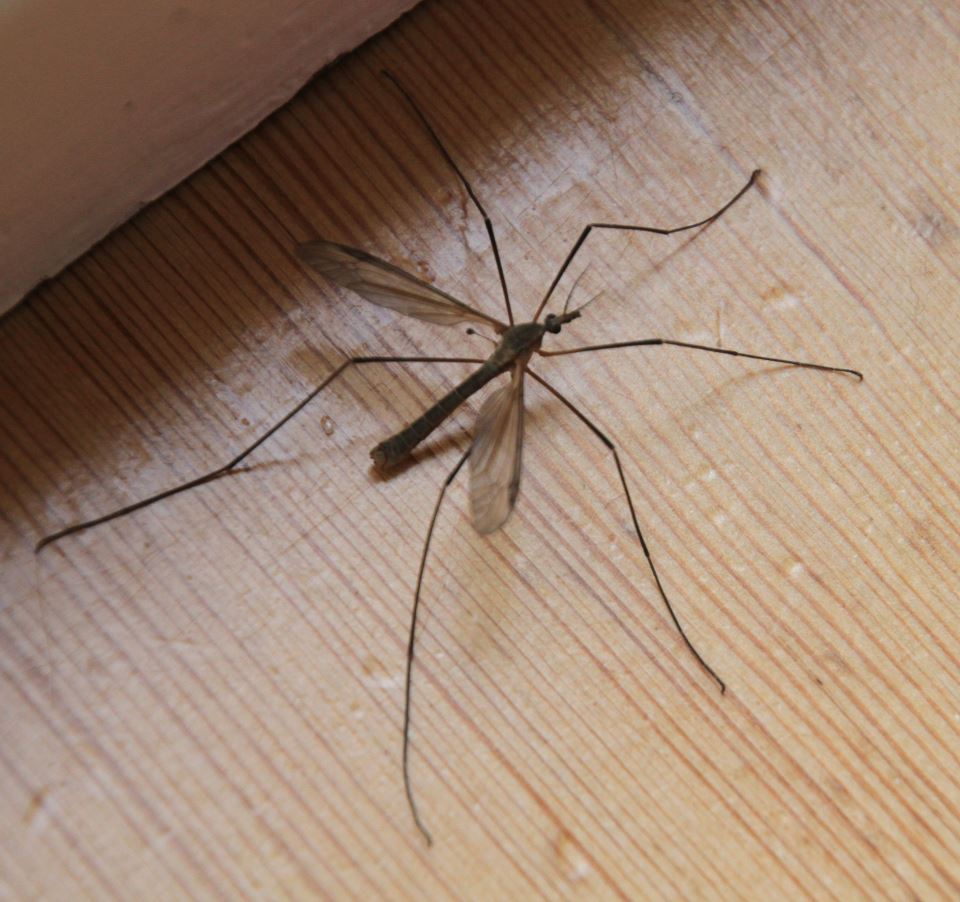

The most common is the Common European Cranefly or Daddy Longlegs Tipula paludosa. In fact during Discover Lundy 2016 there was a mass emergence of this large cranefly when thousands of them appeared in moth traps, properties and all over the plateau.
Hoverflies are mimics and could be confused with bees or wasps but significantly, as Diptera, they have only two wings. The Marmalade Hoverfly Episyrphus balteatus, Bumblebee Hoverfly Volucella bombylans and the Pied Hoverfly Scaeva pyrastri all occur on the island.
The complete list of species recorded on Lundy can be viewed here.
Bees, Wasps and Ants (Hymenoptera)

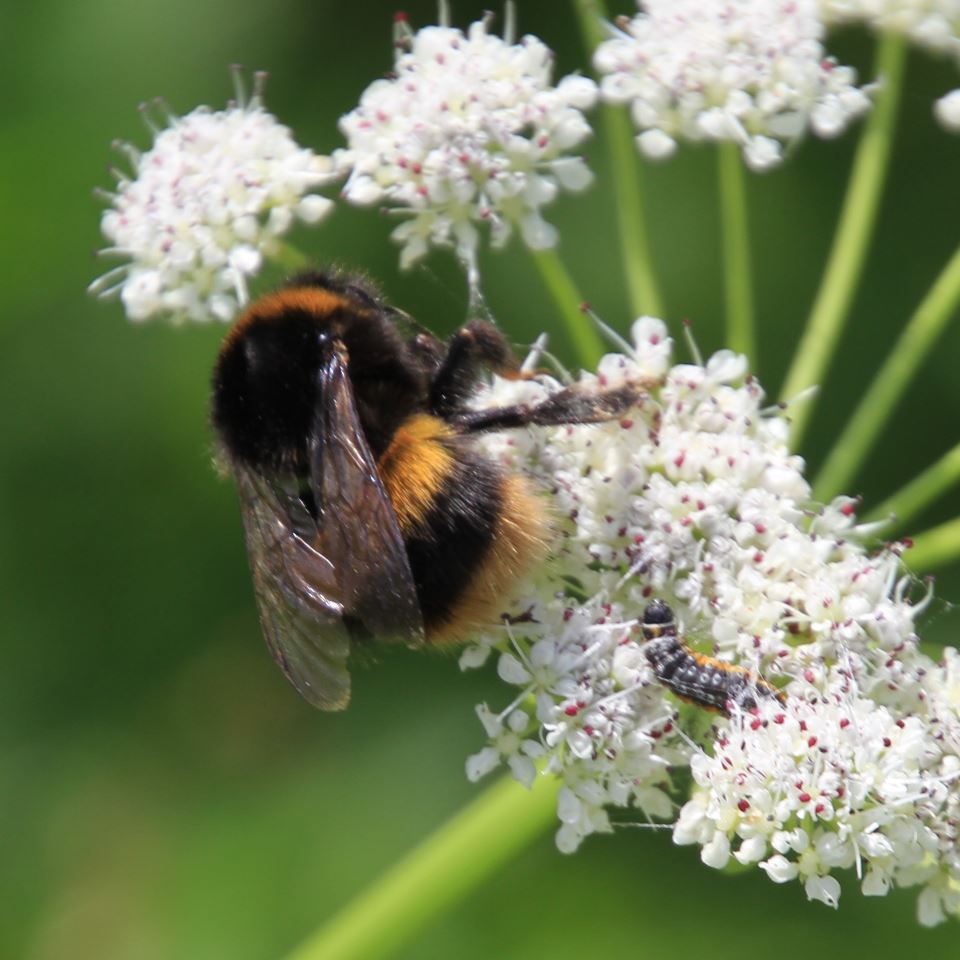 Two bees are regularly seen and reported – the White-tailed Bumblebee Bombus leucorum and the Buff-tailed Bumblebee Bombus terrestris. The species are easily separated by the distinctive colour of the dorsal tip of the abdomen.
Common Black Ants Lasius niger can be found nesting under stones and will often reveal their companion species the Ant Woodlouse Platyarthrus hoffmannseggii.
The complete Lundy list of Hymenoptera may be viewed here.
Other groups
View the Lundy lists of Earwigs and Bristletails.
Text by Alan Rowland
Grey Seals
 The world population of around 280,000 Grey Seals Halichoerus grypus is confined to the North Atlantic and the Baltic Sea with a large proportion found within British waters. In general, number are increasing, althougn numbers in the Baltic, primarily in the Gulf of Finland) are in substantial declione. Preferring remote stretches of coastline, the majority of British Grey Seals occur along the western coast, particularly off the west coast of Scotland, but they can also be found on the east coast as far south as Lincolnshire.
Lundy is home to a breeding colony of around 60 Grey Seals, with up to double this number in the summer. They can be seen all around the island, particularly at their 'hauling-out' spots such as Seals's Rock, north of Gannet's Rock, Brazen Ward, Surf Point, Shutter Point and Rat Island. When out of the water they will lie on rocky ledges, ofter in groups, basking in the sunshine. However, they remain alert to danger and will heave themselves into the water if disturbed or threatened in any way. In the water, seals are often seen 'bottling' - staying upright with only their head showing above water. They can probably sleep in this position.
Recognition
 Bull Grey Seals are larger than cows with a distinct 'roman nose' profile to the head. Bulls also tend to be darker in colour, although both sexes have blotchy markings from black through shades of grey to brown and are lighter on their undersides. The patterns of blotches, particularly those on the upper body, may be used to identify individuals and studies using this technique have shown the same animals to be present around Lundy year after year. Adult bulls may grow to 3m (10ft) in length and weigh over 270kg (600lbs), but females typically measure around 1.8m (6ft). Male Grey Seals live for an average of 25 years and females for 35 years.
Breeding
Grey Seal pups are normally born with a white coat of fur in September or October, but are unable to swim immediately after birth so an undisturbed beach is usually chosen by the mother. On Lundy the intertidal sea caves, the far ends or which remain above the high water mark, are also used. At birth the pups are 85cm (3ft) long and weigh about 14kg (30lbs), but are vulnerable being washed off beaches by rough seas and to disturbance by humans. On a diet of high-fat milk they treble their weight over their first three weeks of life, and then moult into their darker coat and start to feed for themselves. First year survival has been estimatyed at around 50% and animals typically do not return to the breeding sites until 4 years of age.
For more information about seals around the coastline of South-west England or to report a seal in distress, please see the Cornwall Seal Group website.
Cetaceans and other seals
Common Dolphins Delphinus delphis can be seen from Lundy, usually between April and October usually in small groups of up to ten and occasionally in large pods of 100 or more. The larger, darker, Bottlenose Dolphin Tursiops truncatrus is much less common with only two or three records each year. Harbour Porpoises Phocoena phocoena are also seen regularly throughout the year, singly or in small groups.
Less commonly seen from the island or on the crossing are Risso's Dolphin Grampus griseus and Minke Whale Balaenoptera acutorostrata.
Common (Harbour) Seals Phoca vituilina are very uncommon in the waters around Lundy, but one was reported on four occasions in the summer of 2015.
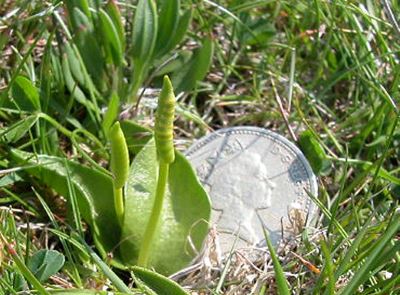 The most obvious fern on Lundy is Bracken Pteridium aquilinum which thrives on the sheltered east side and on top of the island where there are deeper soils, but it even grows on the exposed western cliffs in a more stunted form. The smallest fern on Lundy is the Small Adder’s-tongue Fern Ophioglossum azoricum, and this diminutive plant is probably more common here than in some of its other sites on the mainland. It grows in the short turf on the western slopes, near Rocket Pole Pond and in Middle Park, often associated with the very small flowering plant Allseed Radiola linoides. Hay-scented Buckler Fern Dryopteris aemula is abundant along the east side, especially around the quarries, but this also grows on the exposed western flanks of the island, such as around Jenny’s Cove and this is also easier to find on Lundy than on the mainland.
Other common fern species on the island are Broad Buckler-fern Dryopteris dilatata, Lady Fern Athyrium foelix-foemina and Male Fern Dryopeteris filix-mas which can all be found in Millcombe and also in the deep rocky crevices of the earthquake. Hart’s-tongue Fern Phyllitis scolopendrium, recognised by its undivided fronds also favours the shelter of Millcombe.
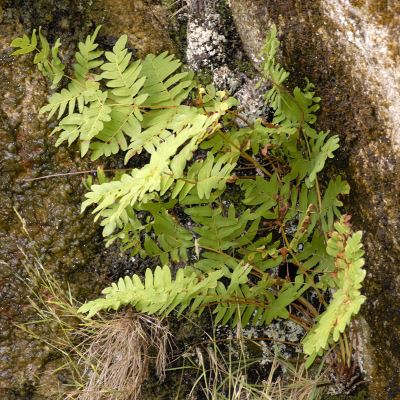 Britain’s largest fern, the Royal Fern Osmunda regalis grows on the east side, and can be found in the quarries, often appearing to grow out of the solid rock, although it is usually more stunted in these situations. Lundy’s stone walls form an important habitat for ferns and other plants and there are fine colonies of Maidenhair Spleenwort Asplenium trichomanes , Black Spleenwort Asplenium nigrum and Common Polypody Polypodium vulgaris, some of them easily found in the village area. There are two colonies of Rustyback Fern Ceterach officinalis on Lundy, both growing on walls, and a very small number of plants of Wall Rue Aspelnium ruta-muraria can be found in two locations. This species is common on the mainland but very scarce on Lundy. Sea Spleenwort Asplenium marinum grows nearer to the sea than other ferns and can be found around the Battery and the wall at the start of the beach road.
Text by Andrew Cleave
The windswept plateau and rocky cliffs of Lundy look rather barren when approaching the island from the sea, but a rich and colourful flora, adapted to life in these exposed conditions, is more obvious once on land. A walk from the Landing Bay, up the beach road, through Millcombe and then to the west side by way of the Old Lighthouse would take in many of the important plant habitats on the island.
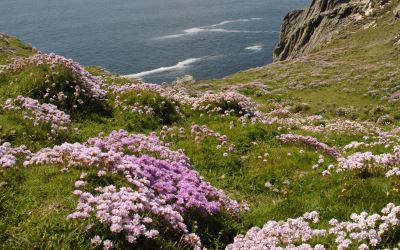 A typical sea cliff flora of Thrift Armeria maritima, Sea Campion Silene uniflora and Sheep’s-bit Jasione montana is found on the exposed sidelands of the island, especially around the Battery and towards the north end. At the south end, and on Rat Island Kidney Vetch Anthyllis vulneraria and Common Sorrel Rumex acetosa are more frequent, and Wild Thyme Thymus polytrichus and English Stonecrop Sedum anglicum grow on rocks and very thin soils. Early spring flowers on the east side include Primrose Primula vulgaris and Bluebell Hyacinthoides non-scripta which flower at their best before the bracken reaches full size. These are followed by forests of Foxgloves Digitalis purpurea, some reaching nearly 3 metres in height, and the much smaller Red Campion Silene dioica. Towards the end of the season Goldenrod Solidago virgaurea is one of the last flowering plants to put on a show of colour and it seems to do best along the edges of the old quarries.
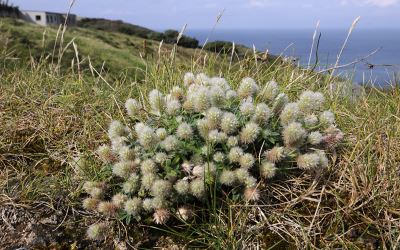 Some of Lundy’s special plants, including the endemic Lundy Cabbage Coincya wrightii can easily be seen from the beach road. Balm-leaved Figwort Scrophularia scorodonia is common here and the beautiful Wood Vetch Vicia sylvatica flourishes on the steep slopes near the bottom of the road. The island’s stone walls are host to plants such as Ivy-leaved Toadflax Cymbalaria muralis and Wall Pennywort Umbilicus rupestris, and Hare’s-foot Clover Trifolium arvense grows on the top of the walls, safe from grazing animals. Fern Grass Catapodium rigidum seems to grow only on walls, along with several species of ferns, described in more detail on the Ferns page.
 The grassland on top of the island is typical of acid grassland in exposed areas, dominated by Purple Moor Grass Molinia caerulea in places, but bright with the flowers of Tormentil Potentilla repens in the early summer. In damp flushes the semi-parasitic Lousewort Pedicularis sylvatica can be found, often in association with Bog Pimpernel Anagallis tenella and Common Milkwort Polygala vulgaris. A good colony of Heath Spotted Orchid Dactylorhiza maculata grows in the grassland surrounding Pondsbury.
 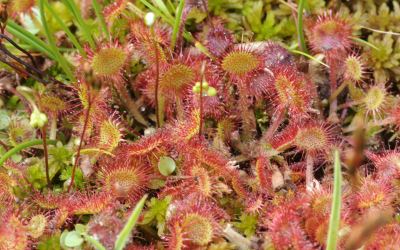 In the wettest bogs, dominated by Sphagnum mosses, Common Cotton Grass Eriophorum angustifolium is very obvious in the summer and the insectivorous Sundew Drosera rotundifolia can sometimes be found. Bog Asphodel Narthecium ossifragum and Marsh St John’s Wort Hypericum elodes grow in the wettest areas and the leaves of Marsh Pennywort Hydrocotyle vulgaris form extensive patches in these wet areas, although its tiny flowers are quite hard to find. The grassland at times gives way to a dense cover of Creeping Willow Salix repens which is most obvious in the spring when the bright yellow catkins appear. Later in the season Cross-leaved Heath Erica tetralix flowers in the wetter areas.
Damp gravelly areas and the margins of seasonal ponds support species like Chaffweed Anagallis minima, the UK’s smallest terrestrial plant. This is now becoming scarce on the mainland but seems to do well on Lundy. Sea Storksbill Erodium maritimum is another species of gravel areas and is abundant on Lundy but much harder to find on the mainland.
On top of the island, especially around Tibbetts (Admiralty Lookout) and towards the north end, there are some fine examples of a habitat type known as maritime, or waved heath. These areas are dominated by Western Dwarf Gorse Ulex gallii which flowers late in the summer, and Ling Calluna vulgaris and Bell Heather Erica cinerea, all providing a spectacular splash of colour.
The more sheltered east side of the island supports the only trees on Lundy which grow in a few small copses in steep coombes. They are mostly hardy species, such as Sycamore Acer pseudoplatanus and Beech Fagus sylvatica, with a number of Turkey Oaks Quercis cerris scattered amongst them. Other native species include Alder Alnus glutinosa, Grey Willow Salix cinerea and Elder Sambucus nigra, and these all provide sheltered conditions for several species of plants more typical of woodland, including ferns, mosses and liverworts. Plants which favour shaded habitats are more at home here and large umbellifers such as Wild Angelica Angelica sylvestris and the invasive Alexanders Smyrnium olusatrum grow where the soil is damp. Various species of introduced conifers can be found in Millcombe, including the native Scots Pine Pinus sylvestris, but they do not thrive here.
Relics of cultivation and former habitation appear in some areas, and there are large stands of an early Narcissus cultivar Primrose Peerless Narcissus x biflora which survives near Belle Vue Cottages above the quarries.
Many interesting plants have been recorded on Lundy in the last 100 years, but some have not been seen recently. They may just have been overlooked, or possibly have vanished altogether. Any records of Lundy's Lost Plants would be most welcome.
As with other species groups we are always keen to receive records. Details of how to submit botanical records can be found here.
Text by Andrew Cleave
There are no articles in this category. If subcategories display on this page, they may have articles.

External links
Downloads
Latest news
Anniversary commemoration

Although our 75th anniversary Discover Lundy event was unfortunately cancelled due to the COVID-19 restrictions, a few members were able to stay on Lundy during the planned week including your Chair and Secretary who met with Derek Green, Lundy's General Manager, to unveil a commemorative picture in the Wheelhouse of the Marisco Tavern.
AGM date announced
As we cannot go ahead with our long-planned AGM on Lundy in May, we have now found a new date for the meeting: Saturday 4th September 2021 at 3.30pm.
Unfortunately we will not be able to hold the meeting in person again this year and we will meet online using Zoom. Details about how to join will be advertised nearer the time but in the meantime please do put the date in your diary.
Looking for fungi on Lundy during Lockdown by Puffin Post
Frustrated by not being able to visit the island in November for his regular survey of Lundy fungi, John Hedger has found a novel way of continuing his studies. With the help of Rosie Ellis, 'Puffin Post' and Royal Mail, he has identified 30 species found on herbivore dung, including 22 new to Lundy. Read more ...